Tuesday, May 31, 2016

Why do you love Canada? Faces of newest residents of Newfoundland and Labrador

Source:CBC NEWS.CA/NEWS/CANADA
At a recent Association for New Canadians event, photographer Andrew Edwards captured dozens of portraits of new residents of this province. 
Each told the association why they love their new country. 
Azarak: Came to Newfoundland from Sudan in 2008
Azarak came to Newfoundland from Sudan
"Canada is my second country and the best country."
Amanail: Came to Canada from Sudan in November 2015
Amanail came to Canada in November from Sudan
"I like Canada because it has freedom and I am free."
Sifa & Charlotte: Young sisters from the Congo came to Newfoundland in December 2015
Sifa & Charlotte, young sisters from the Congo
"Canada… is a safe country and everyone has the right to choose friends."
Noway: Came to Canada in September with his mother and siblings
Noway is a young man from Eritrea
He is proud of the fact that, "Here in Canada, we have full freedom of human rights." 
Debora, Ferdinand, Tereza, Naomi and Divine: Came to Canada together in March 2015 from Burundi 
Debora, Ferdinand, Tereza, Naomi and Divine came to Canada together in March 2015
The students attend the ANC ESL Training Centre where they study English five days a week. They all agree that "Canada is a peaceful country."
Dhan and Asman Kumari: Originally from Bhutan but spent many years in Nepal before immigrating to Canada in 2013 with their children
Dhan Kumari
Asman Kumari
"In Canada, I like the freedom, the people, and going to school."

Friday, May 27, 2016

Farm Allows Refugees to Get Back to Roots While Growing Business

 BY 

WEST DES MOINES, Iowa –It started as a vision from former refugees, who wanted to get back to their roots and grow their own produce here in Iowa. The dream is now a reality on the Global Greens Farm.
The Bhandari family works together growing produce on a plot of land.
"We are happy to have land and grow our own produce, especially the crops, the vegetables we don't find in the grocery story we like to eat, our cultural crops," Tika Bhandari said.
You'll find potatoes, tomatoes, lettuce varieties and more on the 100 x 100 plot in West Des Moines.
“My dad was a farmer back in Bhutan for 18 acres of land," Tika said.
The Bhandaris are from Bhutan. They spent 18 years in a refugee camp in Nepal before coming to Des Moines. They are now U.S. citizens. They started growing produce on the Global Greens Farm three years ago. The Global Greens Farm is part of a program through Lutheran Services in Iowa to help refugee farmers get back to their roots.
"In 2013, Valley Church and Valley Community Center provided this land for us, and it started with a vision from former refugees who farmed in their home country and had a desire to get back to the land and grow food again here," said LSI Director of Refugee Community Services Nick Wuertz.
Farmers sell the food at farmers markets, the Iowa Food Co-op and through community supported agriculture.

Sunday, May 1, 2016

Local inventor designs automatic doma peeler

Invention: A few kilometres from Gola Bazaar in Sipsu is a small village of Girigaon. And here is a man that locals call “scientist”.
Budhiman Mongar, 52, is famous. He is always thinking about creating or inventing something. His mind works like a machine.
This is the same man who some years ago wanted to build a helicopter. He did but the chopper could not fly. The project proved too expensive and he ran out of budget.
“The dream has not died,” says Budhiman, looking over the craps of the machine he so wanted to see hover in the sky. “I will succeed someday.”
While he has stashed his dream of building a flying machine temporarily, Budhiman is on to his next project – building a machine that can peel 100 domas in a go.
Peeling doma is an exhausting enterprise. And this sure is a good news for paan shops.
“Such a machine doesn’t exist. And that’s exactly what I am going to create,” says Budhiman, who expects to complete his project in about a month. “This machine can peel more than 100 domas automatically in less than 10 minutes.”
The idea struck him about two years when he was sitting by a paan shop looking at a guy peeling doma. Not long after, Budhiman developed a prototype without automation.
Now, though, everything is pretty much all set. Nuts and bolts, blades, wire…all ready to give shape and roar to the machine.
“All I now need is some peace to focus on my project,” says the village scientist. “Complete peace is what I seek.”
Already Budhiman has received orders from doma sellers in Samtse. That means he must work hard. Building one doma-peeling machine will cost him no less than Nu 6,000.

Sunday, April 24, 2016

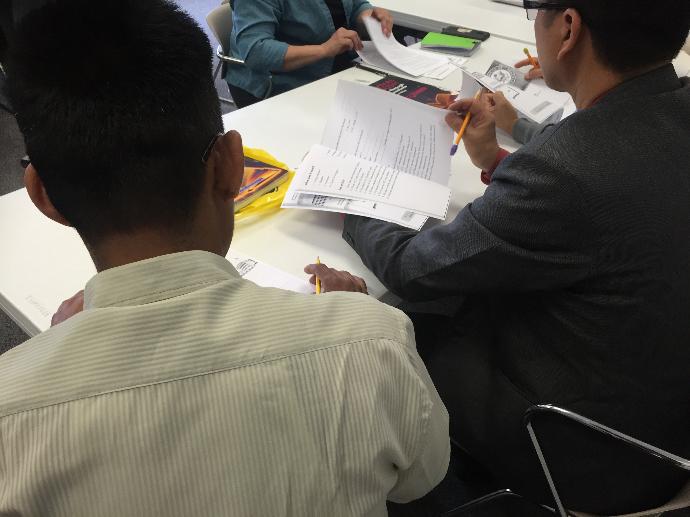
Hiawatha Public Library provides permanent home for Bhutanese learners

By:Brea Love.
HIAWATHA, Iowa (KCRG-TV9) – The Hiawatha Public Library teamed up with the
 Catherine McAuely Center to provide English classes for a group of Bhutanese refugees.

The group fled their home of Bhutan out of need and moved to American start a new life.
Most of 
them settled in Hiawatha, but with the Catherine McAuely Center’s downtown
location, 
many of them had no means of transportation.
That’s when the Hiawatha Public Library offered to turn the center’s English course
 into a library program, which provided a permanent space within a mile radius of
their homes.
“We offered that space to them and it has just blossomed into a really great program,”
Library Director
 Jeaneal Weeks said. “The Bhutanese people come every week, and they’re so excited
 to learn. When there is no class they come asking for class.”
It’s that dedication that inspires the instructor Katie Lanius. She said teaching the course
 is her favorite part of the week.
“This group is so motivated and so hardworking that I kind of feed off of their enthusiasm,”
 Lanius said. “They are walking a mile or two to come to class. They do it in the freezing
 temperatures, they do it in the rain, when it’s really warm in the summers, so they’re
motivation is extremely high.”
The students are a variety of ages, between 20 and 70 years old. Some of them have at most
six years of education, others have none. Lanius spends time working on things as simple
as colors or some of the more advance students preparing for their citizenship interview.
“Anyone can learn English at any age, but the older you get the more challenging it gets
 your brain just isn’t as quick or receptive to picking up a new language,” she said.
Student Bala Edhikari is studying for his citizenship. He said he’s thankful he has the
opportunity to come to class every week.
“We have no English in our country we are from Bhutan, we are learning English here,
some people don’t know how to write read,” Edhikari said. “They teach everything, 
but some of my friends they don’t know.”
Lanius uses patience and repetition, and assures each student they can learn with time.
“The English empowers them to be more comfortable talking with their children’s teachers,
my students are now being able to obtain jobs,” she said.
Lanius is grateful for the library and their help to make sure these Bhutanese students 
succeed.

Avenue W: A gathering place for all nations

By:Thia James.
Chhiring Tamang was only nine years old when her family had to leave Bhutan to live in a refugee camp in Nepal.
Nearly three years ago, she and her husband left Nepal for Canada, following her brother Ramesh’s path to a new life in Saskatoon. Ramesh is the Nepalese group’s pastor at the Meadowgreen House for All Nations on Saskatoon’s Avenue W South, where Chhiring — known as Puunam to those closest to her — learns English.
There, they also found a friend in Pastor Rick Guenther, who oversees the House for All Nations.
“He can help us, everything. How to respect people, how to deal with friends, everything when we move to another place,” she says.
Chhiring lived in the Nepalese refugee camp for 18 years. Her family’s home was made of bamboo and their kitchen was constructed with mud. The home was decorated with paper crafts.

The family was among the many thousands of ethnic Nepalese who were subject to restrictive policies in Bhutan. The Bhutanese royal government enacted those policies in the late 1980s out of fear over the growing ethnic Nepalese population within its borders.
Her grandmother urged the family to leave Bhutan and join her in the refugee camp out of fear for their safety.
When she came to Saskatoon, she went to the Open Door Society.
“Very difficult when we came here,” she recalls. “In my country, we always speak our language only. Only Nepalese.”
At school, she took English classes. At home, she spoke Nepalese.
After taking programs through the Open Door Society — one of the programs partnered with the Meadowgreen House for All Nations — she found work at Superstore.

Refugees in West Michigan: A growing population looking for help

WEST MICHIGAN – Former refugee Krishna Bista is helping hundreds of fellow Napoli refugees establish a new life after being forced from their homes in their native country.
“At age 5, in 1990, I left Bhutan with my uncle’s family and grandma,” said Bista. “We were part of a mass exodus of culturally Nepali Bhutanese expelled by the King of Bhutan who wanted to create an ethnically pure society."
For the next 18 years, Bista lived in a refugee camp in southeastern Nepal, losing hope along the way.
“I remember thinking once that God had created refugees because He took delight in their misery,” said Bista.
Bista came to Grand Rapids as a refugee with his family in 2008, finding his struggle had just begun.
“The biggest problem is the language, language is the big issue,” said Bista.

My Speech during the Refugee Rights Day in Charlottetown,Canada